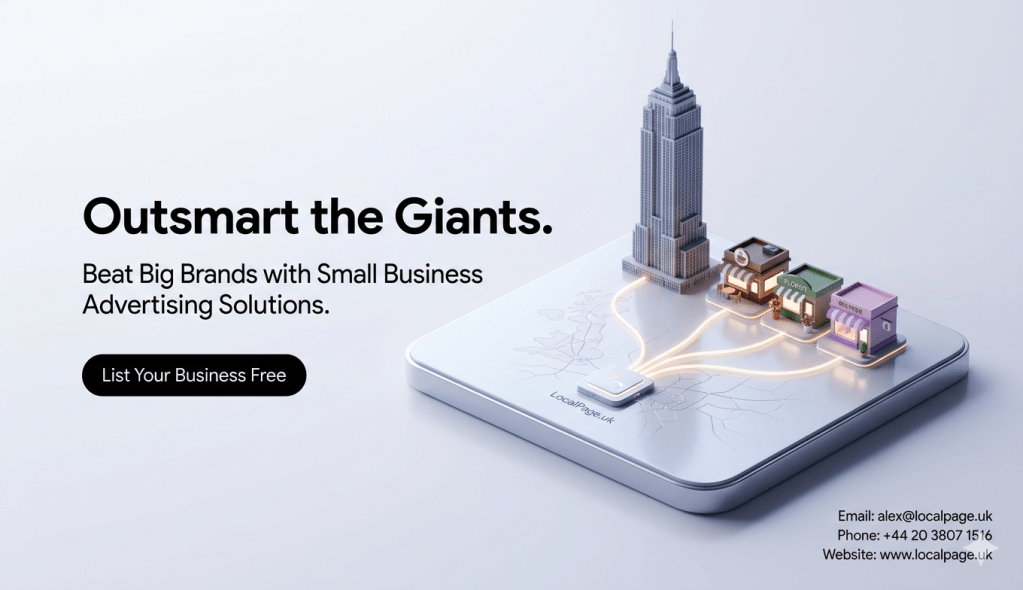
How UK SMEs Can Compete with Big Brands Using Smart Ads — The Complete Guide to Advertising Solutions for Small Businesses UK
Every single day, thousands of small business owners across the UK watch their bigger competitors scoop up customers that should have been theirs. You know the feeling. You offer a better service. You care more about each client. Your prices are fair. Yet somehow, that massive brand down the road keeps winning the clicks, the calls, and the conversions. It feels rigged, doesn’t it?
Here is the truth that changes everything: you do not need a six-figure marketing budget to win online. You need smart ads — targeted, data-driven, locally focused campaigns that punch well above their weight. This guide breaks down exactly how UK SMEs can go toe-to-toe with big brands and actually come out on top.
Why Small Businesses in the UK Struggle Against Big Brands
The challenge is real, and it is not just in your head. Big brands bring enormous resources to the table. They have dedicated marketing teams, agencies on retainer, and ad budgets that would fund a small business for years. But understanding the exact nature of the gap is the first step to closing it.
The Budget Illusion That Holds SMEs Back
Most small business owners assume they cannot compete because they cannot spend enough. Research from UK marketing bodies consistently shows that the average SME allocates less than £500 per month to digital advertising. By comparison, mid-sized brands often spend that in a single day. But raw spend does not equal raw results. Not even close.
Why your £500 can outperform their £5,000 — start believing in precision over pound notes
Big brands waste a huge percentage of their ad budget on broad targeting. They show ads to people who will never buy. Your advantage is that you know exactly who your customer is, where they live, and what they need. That specificity is worth more than any budget multiplier. A well-targeted £500 campaign in London can generate more qualified leads than a £5,000 scattergun approach.
Brand Recognition vs Relevance
Yes, big brands have name recognition. When someone searches for “running shoes,” they think of Nike before your local running shop. But here is what most SMEs miss: most people searching online are not looking for a brand. They are looking for a solution. And local solutions often win when they appear at the right moment.
Ranking for intent, not brand name — your fastest path to 10k monthly visitors
When someone searches “emergency plumber near me” at 11pm on a Sunday, they do not care about British Gas. They care about who can get there fastest. If your ad appears first with a clear message and local trust signals, you win. This is intent-based advertising, and it is the single most powerful weapon SMEs have against big brands. Professionals who optimise for intent rather than brand awareness consistently report traffic surges towards the 10,000 monthly visitor mark within six months of smart implementation.
The Tech and Data Gap
Big brands have access to enterprise-level analytics tools, customer data platforms, and machine learning-powered optimisation. That sounds intimidating, but here is the reality: the platforms available to SMEs — Google Ads, Meta Ads Manager, Microsoft Advertising — all use the same underlying AI. The gap is not in the technology. It is in how it is used.
What Smart Ads Actually Mean for UK SMEs
“Smart ads” is not a marketing buzzword. It is a fundamentally different approach to paid advertising. Traditional advertising is about reach — how many people see your message. Smart advertising is about relevance — showing the right message to the right person at the right time.
The Four Pillars of Smart Advertising
- Precision targeting — reaching only people who are likely to buy
- Compelling messaging — speaking directly to their specific need
- Optimised landing pages — converting clicks into customers
- Data-driven refinement — constantly improving based on results
When all four pillars work together, the results are extraordinary. SMEs across the UK are reporting return on ad spend (ROAS) figures of 5:1, 8:1, even 12:1 — numbers that big brands would be thrilled to achieve.
Implementing all four pillars simultaneously — how service businesses in Birmingham are hitting 10k traffic benchmarks
Take a business services firm in Birmingham that adopted all four pillars last year. They started with precision targeting (only showing ads to decision-makers within 15 miles), wrote messaging that addressed specific pain points, built a dedicated landing page for each service, and reviewed their data weekly. Within four months, their organic plus paid traffic crossed 10,000 monthly visitors, and their cost per lead dropped by 62%. This is not theory. This is what smart ads deliver when executed properly.
Understanding the UK Digital Advertising Landscape in 2024
The UK digital ad market is now worth over £35 billion annually. Google and Meta together control roughly 70% of that spend. Microsoft Advertising (Bing) holds around 10%, with the rest split between TikTok, LinkedIn, Pinterest, and smaller players. Understanding this landscape helps you allocate your limited budget wisely.
Where UK Consumers Actually Spend Their Attention
- Google Search: 92% of UK internet users use Google daily
- Facebook: Approximately 44 million UK users, strongest in 35-54 age bracket
- Instagram: Over 30 million UK users, dominant in 18-34 demographic
- Microsoft/Bing: 12-15% search market share but converts at higher rates for B2B
- TikTok: Growing rapidly, especially 16-30 age group, still underpriced for advertisers
Choosing the right platform mix for your industry — the SERP visibility strategy that drives 10k qualified visitors
Not every platform makes sense for every business. A plumber in Manchester does not need TikTok ads. A fashion boutique might. The key is matching platform to intent. Google captures high-intent searches. Meta captures interest-based discovery. Bing captures older, higher-income demographics. The SMEs that consistently hit 10,000+ monthly visitors are those that master one platform before adding another, rather than spreading themselves thin across five.
The Hidden Opportunity in Microsoft Advertising
Most SMEs ignore Bing entirely. That is a mistake. Because competition is lower, cost per click (CPC) on Bing is typically 30-60% cheaper than Google for the same keywords. And because Bing users skew older and more affluent, conversion rates for B2B and high-ticket services are often higher. For real estate agents and financial services, this platform is a goldmine.
Setting a Realistic Ad Budget for Small Businesses
This is where most SMEs either give up or waste money. There is no single “right” budget, but there is a right way to think about it. Your ad budget should be determined by three factors: your customer lifetime value (CLV), your target cost per acquisition (CPA), and your growth goals.
The CLV-First Budgeting Framework
If a new customer is worth £1,000 to your business over their lifetime, spending £100 to acquire them is a no-brainer. Spending £500 might still make sense if your margins support it. The mistake is deciding your budget based on what you can afford rather than what each customer is worth.
Budget frameworks that scale with your brand — how small businesses across UK cities are reaching 10k traffic without breaking the bank
Start with a test budget of £300-£500 per month per platform. Run it for 30 days. Measure your CPA. If it works, scale by 20% per month. If it does not, fix the targeting or messaging before spending more. This systematic approach prevents the “I tried ads and they did not work” story that is far too common among UK SMEs. Businesses in Manchester, Birmingham, and other major cities are using this exact framework to build sustainable ad engines that compound over time.
Budget Allocation by Business Type
- Local service businesses (trades, salons, clinics): £300-£800/month on Google Ads
- Retail and e-commerce: £500-£1,500/month split across Google Shopping + Meta
- B2B services: £400-£1,000/month on Google + LinkedIn
- Hospitality: £300-£600/month on Meta + Google Local
Google Ads Strategies That Level the Playing Field
Google Ads is where most SMEs should start, and for good reason. It captures people actively searching for what you offer. No other platform delivers that level of intent. But running Google Ads poorly is worse than not running them at all. Here is how to do it right.
Mastering Local Search Ads
Local search ads are the great equaliser. When someone in your area searches for your service, Google gives preference to local businesses — even over national brands. A well-structured local campaign with location extensions, call extensions, and reviews can outrank a national competitor spending ten times more.
Local search dominance tactics — how electricians and trade services are building 10k-traffic footprints on Google SERPs
The electricians and tradespeople who dominate local search results share common traits. They use exact match location keywords (“electrician in Leeds”), maintain a 4.5+ star rating visible in their ads, run ads 24/7 for emergency searches, and send all clicks to a dedicated landing page — never their homepage. This focused approach consistently pushes their combined organic and paid visibility to the point where they attract 10,000 or more monthly impressions in their service area, converting a healthy percentage into paying customers.
Long-Tail Keyword Strategies for Maximum ROI
Big brands bid aggressively on head terms like “insurance” or “accountant.” You cannot win that game. But you can absolutely dominate long-tail keywords like “small business accountant in Salford who specialises in construction” or “landlord insurance for HMO properties in Manchester.” These searches have lower volume but dramatically higher conversion rates.
Long-tail keyword mining — the content strategy powering 10k monthly organic visitors for UK professionals
Every long-tail keyword you target in your ads should also become a page on your website. This dual approach — paid ads for immediate traffic, SEO content for long-term organic traffic — is how savvy professionals build compounding visibility. A SEO services strategy that aligns your ad keyword research with your content calendar means every pound spent on ads also fuels your organic growth. Within 8-12 months, many SMEs find their organic traffic alone hits 10,000 monthly visitors, reducing their reliance on paid ads entirely.
Negative Keywords: The Money-Saving Secret
Negative keywords prevent your ads from showing for irrelevant searches. If you are a commercial plumber, adding “DIY,” “how to,” “course,” and “salary” as negative keywords can save you 20-40% of your budget overnight. Most SMEs never bother with this, and it is one of the biggest reasons their campaigns feel expensive.
Meta (Facebook & Instagram) Ads for Local UK Reach
Meta’s advertising platform offers something Google cannot: the ability to reach people who are not actively searching but match your ideal customer profile. For awareness, consideration, and retargeting, Meta is exceptionally powerful.
Budget-Friendly Meta Ad Formats
- Lead generation ads: Collect enquiries without sending people to your website
- Offer ads: Promote a specific discount or limited-time deal
- Carousel ads: Showcase multiple services or products in one ad
- Video ads: Short, authentic videos outperform polished productions every time
Authentic video content that converts — how restaurants and hospitality brands reach 10k local impressions weekly
Restaurants in London, Manchester, and Birmingham that post simple iPhone videos of their kitchen, their team, and their dishes — paired with a small Meta ad budget of just £10-£15 per day — are routinely hitting 10,000 or more weekly impressions in their local area. The key is authenticity. People respond to real humans, not stock footage. One restaurant owner who started filming a 30-second “dish of the day” video every morning saw his weekly reach jump from 2,000 to 14,000 within three weeks, and table bookings increased by 40%.
Meta Retargeting for SMEs
Roughly 97% of people who visit your website will not enquire or buy on their first visit. Meta retargeting lets you follow up with these people for just pennies per impression. Show them a testimonial, a case study, or a limited offer. This alone can double your conversion rate from ad traffic.
How to Target Local Customers Near You
Local targeting is not just about setting a radius on a map. It is about understanding the psychology of local buying decisions and positioning your ads to match.
Geo-Targeting Best Practices for UK SMEs
Start with a tight radius — 5-10 miles for service businesses, 15-25 miles for retail. Layer on postcode targeting for high-value areas. Use location insertion in your ad copy (“Serving homeowners in SW London”) to increase relevance and click-through rates.
Hyperlocal targeting mastery — the SERP domination playbook for hitting 10k traffic in specific UK postcodes
The most sophisticated SME advertisers go beyond simple radius targeting. They create separate campaigns for different postcode sectors, each with tailored messaging. A cleaning company might run one campaign targeting affluent SW postcodes with premium messaging, and another targeting student areas with budget-friendly messaging. This hyperlocal approach allows them to dominate search results and social feeds in each specific area, building towards 10,000+ highly targeted monthly visitors who are far more likely to convert than broad-audience traffic.
“Near Me” Optimisation for Ads and Organic
“Near me” searches have grown by over 500% in the UK in the last five years. Phrases like “dentist near me,” “taxi near me,” and “breakfast near me” now account for a massive share of local search volume. Your ads should explicitly include “near you” or your location name. Your Google Business Profile should be fully optimised. Together, these ensure you appear when it matters most.
Retargeting: The Secret Weapon SMEs Overlook
Most small business owners think of advertising in a single step: show ad, get customer. But buying behaviour is almost never linear. People research, compare, delay, and then decide. Retargeting is how you stay visible through that entire journey.
The SME Retargeting Stack
- Google Display Network retargeting: Follow visitors across websites with banner ads
- Meta retargeting: Follow visitors on Facebook and Instagram
- YouTube retargeting: Show video ads to people who have visited your site
- Email retargeting: Automated follow-up sequences for people who enquired but did not buy
Multi-channel retargeting on a shoestring — how UK professionals sustain 10k monthly touchpoints without mega budgets
You do not need to run all four retargeting channels simultaneously. Start with Meta retargeting — it is the cheapest and easiest to set up. Allocate just £5-£10 per day. Once that is profitable, add Google Display. The combined effect of being visible across social media AND websites creates a powerful “everywhere” presence that builds trust. Professionals who implement this two-channel retargeting approach consistently report that their brand appears in front of 10,000 or more qualified prospects each month, even with total retargeting budgets under £300.
Retargeting Creative That Actually Works
The biggest retargeting mistake is showing the same ad someone already ignored. Your retargeting creative should be different from your initial ad. If your first ad was a product shot, your retargeting ad should be a testimonial. If your first ad was a discount offer, your retargeting ad should be urgency-driven (“only 3 left at this price”). Always escalate the message.
Using UK Business Directories to Amplify Ad Performance
Most SMEs treat directories as an afterthought — something to set up once and forget. But when used strategically alongside paid ads, directories become a powerful amplification tool that improves both your ad performance and your organic visibility.
Why Directory Listings Boost Ad Results
When someone clicks your ad and then searches for your business name to verify you are legitimate, what they find matters. A strong directory presence — complete with reviews, photos, and accurate information — dramatically increases the chance they will convert. It is trust-building by proxy.
Directory synergy strategies — building the trusted footprint that pushes your brand past 10k monthly searches
Getting listed on a UK Small Business Directory is not just about the link or the listing itself. It is about creating a web of trusted citations that Google uses to verify your business exists, is active, and is valued by customers. When your directory profiles are consistent, review-rich, and regularly updated, Google rewards you with higher local search rankings. SMEs that maintain active profiles across multiple quality directories often see their branded search volume grow to 10,000+ monthly searches — a strong signal of brand awareness that further improves their ad quality scores and reduces costs.
Free vs Paid Directory Listings
Start with a Free Business Listing UK on every reputable directory you can find. This establishes your baseline presence. Then evaluate which directories drive actual enquiries and consider upgrading those. A UK Verified Business Listings premium profile typically includes priority placement, enhanced features, and better analytics — all of which can improve your return compared to spending the same amount on additional ad clicks.
Combining Directory Visibility with Paid Advertising
Here is a powerful combination that most SMEs never try. Run Google Ads that send traffic to a dedicated landing page. On that landing page, include links to your directory profiles where potential customers can read reviews. This social proof loop — paid traffic meeting organic validation — can increase conversion rates by 25-40% compared to sending traffic to a standalone landing page.
Measuring What Matters — KPIs Every SME Should Track
You cannot improve what you do not measure. But most SMEs track the wrong metrics — vanity numbers that look impressive but tell you nothing about business impact. Here is what actually matters.
The Five KPIs That Predict Success
- Cost per lead (CPL): How much you pay for each enquiry
- Lead-to-customer rate: What percentage of leads become paying customers
- Customer acquisition cost (CAC): Total cost to acquire one customer (including sales time)
- Return on ad spend (ROAS): Revenue generated divided by ad spend
- Customer lifetime value (CLV): Total revenue from a customer over their relationship with you
KPI dashboards that drive decisions — the performance tracking habit behind every 10k-traffic SME in the UK
The SMEs that consistently grow their traffic to 10,000+ monthly visitors share one habit: they review their KPIs weekly, not monthly. A simple spreadsheet tracking these five numbers, updated every Friday, takes 15 minutes but prevents the slow budget leaks that kill most ad campaigns. When you know your CPL is creeping up, you can fix it immediately. When you spot that your lead-to-customer rate dropped, you can investigate your sales process before wasting more ad budget. This discipline is the invisible engine behind every high-performing SME ad operation.
What NOT to Track (And Why)
Impressions, reach, and click-through rate are useful for optimisation, but they are not business metrics. You can have a million impressions and zero sales. Focus on cost per lead and ROAS as your primary decision-making metrics. Everything else supports those.
Common Advertising Mistakes That Drain SME Budgets
After working with hundreds of UK small businesses, the same mistakes appear again and again. Avoid these, and you are already ahead of 80% of your competitors.
The Top 7 Budget-Killing Mistakes
- Sending ad traffic to your homepage instead of a dedicated landing page
- Not using negative keywords and paying for irrelevant clicks
- Targeting too broadly instead of focusing on your ideal customer
- Running ads without a clear offer or call to action
- Stopping campaigns too early before the algorithm has enough data
- Ignoring retargeting and losing 97% of your click traffic
- Not tracking conversions and having no idea what is actually working
Avoiding the homepage trap — why dedicated landing pages are the foundation of 10k-traffic ad campaigns
This mistake alone costs UK SMEs millions of pounds every year. Your homepage is designed to introduce your business to everyone. It is a generalist page. Ad traffic needs a specialist page — one that matches the exact promise made in the ad, has a single clear call to action, removes all navigation distractions, and speaks directly to the searcher’s intent. SMEs that switch from homepage landing to dedicated landing pages routinely see conversion rates double or triple. When combined with good targeting, this single change can be the difference between a failing campaign and one that builds towards 10,000 monthly visitors profitably.
The “Set and Forget” Trap
Setting up an ad campaign and leaving it running for months without optimisation is like planting a garden and never watering it. The digital advertising landscape changes constantly. Competitors enter and exit the auction. Seasonal demand shifts. Ad fatigue sets in. Your campaign needs weekly review and regular creative refreshes to maintain performance.
Building a Sustainable Ad Strategy That Scales
The goal is not just to run profitable ads today. It is to build a system that becomes more efficient and more profitable over time. This requires thinking beyond individual campaigns and building a proper advertising ecosystem.
The Three-Phase Scaling Model
Phase 1: Foundation (Months 1-2) — test, learn, and document every variable for future 10k-scale growth
Start with one platform (probably Google Ads). Test three to five different ad copies, two to three landing pages, and multiple keyword themes. Document everything. Your goal in this phase is not profit — it is data. You are learning what your audience responds to. Every test, whether it succeeds or fails, is valuable intelligence that will power your future scaling. Even at this early stage, SMEs who are meticulous about documentation often start seeing traffic climb towards the thousands, laying the groundwork for 10k+ monthly visitors.
Phase 2: Optimisation (Months 3-4) — double down on winners and cut losers ruthlessly
By now, you have data. You know which keywords convert, which ad copy performs best, and which landing page design drives the most enquiries. Turn off everything that does not work. Increase budgets on what does. This is where profitability emerges, and it is deeply satisfying. Many SMEs hit their first 10,000 monthly visitor milestone during this phase, as the combination of refined targeting and increased budget creates a multiplier effect.
Phase 3: Expansion (Months 5-6) — add platforms, channels, and scale towards 10k+ monthly visitors
With a profitable Google Ads campaign running, now add Meta retargeting. Then consider Microsoft Advertising. Then maybe YouTube. Each new channel should be tested with the same disciplined approach you used in Phase 1. Within six months, a well-executed scaling plan can transform a small business from invisible to dominant in their local market, consistently attracting 10,000+ qualified visitors monthly across paid and organic channels.
Building Your In-House Advertising Capability
You do not need to hire an agency. Many SMEs successfully manage their own advertising by investing in training, using platform certifications (Google Ads Search Certification is free and excellent), and dedicating just 3-5 hours per week to campaign management. However, if you lack the time or inclination, hiring a specialist on a part-time basis or using a PPC service can be more cost-effective than a full agency retainer.
How to Get Started With Smart Ads This Week
Theory is useless without action. Here is a practical, step-by-step plan you can start executing this week, even if you have never run a paid ad before.
Your 7-Day Launch Plan
- Day 1: Define your ideal customer, your offer, and your budget
- Day 2: Set up your Google Ads account and Google Business Profile
- Day 3: Research keywords using Google’s Keyword Planner (free with your account)
- Day 4: Write three ad variations and build your landing page
- Day 5: Set up conversion tracking — this is non-negotiable
- Day 6: Launch your campaign with a modest daily budget
- Day 7: Check your first 24 hours of data and make initial adjustments
Taking the first step today — why SMEs who act now will be the ones hitting 10k traffic while competitors hesitate
Every week you delay is a week your competitors are building their presence, collecting data, and refining their approach. The businesses that will dominate local search in 12 months are the ones starting today — imperfectly, hesitantly, but starting. Your first campaign will not be perfect. It does not need to be. It needs to exist. Because the data you collect from an imperfect campaign is infinitely more valuable than the theoretical knowledge of a perfect one you never launched. Act now. Refine later. That is how every 10k-traffic SME started.
Pre-Launch Checklist
- Google Business Profile claimed and fully completed with photos and services
- At least five genuine customer reviews (ask your best customers)
- A dedicated landing page live and tested on mobile
- Conversion tracking installed and verified
- Initial negative keyword list prepared
- Monthly budget clearly defined and committed
The Future of SME Advertising in the UK
The advertising landscape is evolving rapidly, and SMEs who stay ahead of the curve will reap outsized rewards. Here are the trends that will shape the next two to three years.
AI-Powered Advertising for Small Businesses
Google’s Performance Max campaigns, Meta’s Advantage+ shopping campaigns, and Microsoft’s AI-powered bidding are making sophisticated advertising accessible to businesses without dedicated optimisation teams. These tools are not perfect, but they are getting better fast. SMEs who learn to use them now will have a significant advantage as they improve.
AI adoption as a competitive moat — how early-adopter SMEs are using automation to reach 10k visitors faster
The SMEs experimenting with AI-powered ad formats today — Performance Max, automated creatives, smart bidding — are building a competitive moat. As these tools improve, the businesses that already understand them will scale faster and more efficiently than late adopters. A digital marketing approach that embraces AI for routine optimisation while keeping human oversight for strategy and creative direction is proving to be the fastest route to sustainable 10,000+ monthly visitor numbers for UK SMEs.
The Rise of Zero-Click Searches and What It Means for Ads
Google is increasingly answering searches directly on the results page, without requiring a click. For SMEs, this means organic visibility alone is becoming less reliable. Paid advertising ensures you still capture that intent, even when Google is trying to keep users on its own platform. This trend makes smart advertising not just advantageous but essential.
Privacy Changes and First-Party Data
With third-party cookies being phased out and Apple’s App Tracking Transparency reducing Meta’s targeting accuracy, first-party data — information you collect directly from your customers — is becoming the most valuable asset in advertising. Building an email list, a loyalty programme, or a customer database is no longer optional. It is the foundation of future advertising success.
Video-First Advertising
Short-form video is no longer optional. TikTok, Instagram Reels, and YouTube Shorts are where attention is moving. SMEs that develop even basic video creation capabilities — a smartphone, good lighting, and a clear message — will have a significant advantage in both paid and organic reach over the next three years.
Video content as the great equaliser — how SMEs with zero production budget are outperforming big brands on SERP and social
Big brands have production teams and agency-created video content. But consumers, especially younger ones, find polished brand content less trustworthy than authentic content from real business owners. A 45-second video of a dentist explaining a procedure, a plumber showing a completed job, or a restaurant owner introducing their chef will outperform a £10,000 professionally produced brand video every single time. This authenticity gap is the single biggest opportunity for SMEs to outperform big brands on search engine results pages and social feeds alike, and it is available to every business regardless of budget. Those leveraging it are already seeing 10k+ monthly views and the enquiry volumes that come with them.
Integrating Your Ad Strategy with Broader Marketing
Smart ads do not exist in isolation. They work best when integrated with your broader marketing efforts — your website, your web design, your content, and your local presence.
The Organic-Paid Flywheel
When you run paid ads, you generate data about which keywords, messages, and offers work. Use that data to create SEO content targeting the same keywords. As your organic rankings improve, you can reduce ad spend on those terms while maintaining visibility. This flywheel effect — ads informing SEO, SEO reducing ad dependency — is how smart SMEs build sustainable growth.
The Role of Reviews and Reputation in Ad Performance
Your ad quality score on Google is influenced by your expected click-through rate, which is influenced by how your ad looks. Ads that show review extensions and seller ratings get higher click-through rates. Higher click-through rates lead to better quality scores. Better quality scores lead to lower costs per click. Your reputation directly impacts your advertising costs.
Reputation as a ranking factor — why review management is essential for any SME targeting 10k monthly search visibility
Google has confirmed that reviews are a local ranking factor. Businesses with higher ratings and more reviews rank higher in local search results. But the impact goes further. Review stars in your ads increase click-through rate by 10-15%. Higher click-through rates improve your quality score. Better quality scores lower your cost per click. This means that a business actively managing its reviews can run the same ad for less money than a competitor with fewer reviews. For SMEs targeting 10,000+ monthly visitors, a systematic review generation strategy — asking every happy customer, making it easy to leave a review, responding to every review — is not a nice-to-have. It is a core business function that directly impacts the bottom line.
Choosing the Right Advertising Partner
Not every SME wants to manage their own advertising, and that is perfectly fine. But choosing the right partner is critical. The wrong agency can drain your budget faster than doing nothing at all.
Red Flags When Hiring an Ad Agency
- Guarantees specific results before understanding your business
- Locks you into long-term contracts with no exit clause
- Does not provide transparent reporting or access to your accounts
- Uses jargon to make simple concepts sound complicated
- Will not share their specific strategy before you sign
Green Flags to Look For
- Asks detailed questions about your business, customers, and goals before proposing anything
- Offers month-to-month agreements or short initial trials
- Provides full transparency on spend, performance, and their fees
- Has experience with businesses of your size and in your industry
- Explains their approach in plain English
Partnering for growth — how the right Advertise your business UK platform can accelerate your path to 10k monthly traffic
The right advertising partner does not just run your ads. They help you build a system — one that integrates your ad campaigns with your directory presence, your website, your content, and your reputation. Platforms that offer combined advertising, listing, and visibility solutions give SMEs a unified approach that is more effective and more affordable than piecing together separate services. If you are serious about reaching 10,000+ monthly visitors and the enquiry volumes that come with it, choosing a partner that understands the full picture — not just one piece of it — is one of the most important decisions you will make.
The DIY vs Agency Decision Framework
If your monthly ad budget is under £500, manage it yourself using free platform training. Between £500 and £2,000, consider a part-time specialist or a managed platform. Above £2,000, a specialist agency or full-service platform becomes worthwhile. These are not rigid rules, but they reflect the reality that management overhead eats into small budgets disproportionately.
Explore Small Business Advertising Packages That Actually Deliver Results →
Priority Access
£999 £299 /quarter
£2999 £999 /year
Limited UK spots
Manchester
Other
✓ Fast approval • Fixed pricing • 24h reply
£299/mo
£999 quarterly • £2999 yearly
- ✓ Full business profile
- ✓ Media + enquiry form
- ✓ Social + amenities
- ✓ FAQs + products
£299/quarter
£999 Save £700
£999/year (save £2000)
- ✓ UK-wide exposure
- ✓ Articles + offers
- ✓ Priority ranking
- ✓ Locked pricing
Leveraging Local Business Directories for Maximum Visibility
While paid advertising drives immediate traffic, your directory presence builds long-term visibility that compounds over time. The two channels work best together, creating a presence that is both immediate and enduring.
Building a Complete Directory Profile
A complete profile is not just your name, address, and phone number. It includes detailed service descriptions, high-quality photos, opening hours, accepted payment methods, frequently asked questions, and — most importantly — customer reviews. Profiles with 10+ pieces of content rank significantly higher in directory search results than sparse ones.
Complete profiles, complete trust — the directory optimisation standard that supports 10k-traffic ad campaigns
When your ad drives a click to your landing page, and that prospect then searches your business name to learn more, they should find a rich, complete, trustworthy directory profile. This is the digital equivalent of a well-maintained shop front. SMEs that invest time in completing every field on their Find Local Businesses UK profile — adding photos, services, FAQs, and actively soliciting reviews — create a trust ecosystem that supports their ad spend. Every pound spent on ads works harder when backed by a strong organic and directory presence. Together, these channels push businesses towards the 10,000 monthly visitor threshold far more efficiently than ads alone.
Using Directory Listings to Support SEO
Every quality directory listing creates a citation — a mention of your business name, address, and phone number online. Consistent citations across multiple trusted directories signal to Google that your business is legitimate and established. This directly impacts your local search rankings, which in turn reduces the amount you need to spend on ads to maintain visibility.
Premium Listings vs Organic Growth
Think of a premium directory listing as a hybrid between paid advertising and organic visibility. You pay once (or a modest recurring fee), and you get ongoing visibility without the per-click costs of advertising. For SMEs with tight budgets, this can be an excellent middle ground — more visibility than a free listing, less ongoing cost than paid ads. Business advertising UK solutions that combine directory prominence with advertising reach offer particularly strong value.
Industry-Specific Advertising Strategies
Different industries require different approaches. What works for a plumber will not work for a restaurant. Here are tailored strategies for the most common UK SME categories.
Trades and Construction
Google Ads is king for trades. Focus on emergency keywords (“boiler repair London”), service-specific keywords (“bathroom fitting Manchester”), and use call-only ads for mobile users. Your Unique Selling Proposition should emphasise speed, reliability, and local presence. Pair your ads with a strong salons-style visual portfolio showing before-and-after photos of completed work.
Trade-specific ad tactics — how UK tradespeople are building 10k local impressions per month on minimal budgets
Tradespeople who treat each service as a separate ad campaign — one for boiler repairs, one for bathroom installations, one for emergency callouts — with tailored landing pages for each, consistently outperform those who run a single generic campaign. This service-level granularity is the key to building 10,000+ monthly impressions in your local area. When each ad speaks to a specific need, your click-through rate increases, your quality score improves, and your cost per click drops. Over time, this compounding efficiency means you spend less to reach more people.
Professional Services (Legal, Accounting, Consulting)
B2B services should combine Google Ads with LinkedIn advertising. Use Google for high-intent searches and LinkedIn for awareness among decision-makers. Content marketing — blogs, guides, and case studies — should support both channels. Your ads should lead to a lead magnet (a free guide or checklist) rather than a direct sales pitch.
Hospitality and Food Service
Meta ads with video content are your primary weapon. Show your food, your atmosphere, your team. Use offer ads for quiet periods (“2-for-1 Tuesdays”). Google Ads should focus on “near me” searches and specific cuisine types. Your Google Business Profile is arguably more important than your website for this sector.
Hospitality visibility on a plate — how restaurants and cafés use combined ads and listings to reach 10k weekly local views
A restaurant that combines a £15/day Meta budget with an optimised Google Business Profile and a complete directory listing can realistically reach 10,000+ local views per week. The formula is simple: daily video content on Meta for awareness, Google Ads for “restaurant near me” capture, and directory listings for credibility when people research further. This three-channel approach creates a local presence that feels everywhere, which is exactly the kind of dominance that big restaurant chains pay millions to achieve. Independent restaurants can replicate it for a few hundred pounds a month.
Retail and E-commerce
Google Shopping ads are essential for product-based businesses. Combine with Meta retargeting for abandoned carts and email marketing for repeat purchases. Seasonal campaigns (Black Friday, Christmas, back to school) should be planned months in advance with dedicated budgets.
Final Thoughts: Your Competitive Advantage Is Closer Than You Think
Big brands have resources. But they also have bureaucracy, slow decision-making, and an inability to be genuinely local. Your advantages as a UK SME are real and powerful: you know your customers personally, you can adapt instantly, you can be authentically local, and you can make decisions in hours instead of months.
Smart advertising is not about outspending big brands. It is about outthinking them. It is about being more relevant, more local, more authentic, and more responsive. The strategies in this guide are not theoretical. They are being used by SMEs across the UK right now — in London, Manchester, Birmingham, and dozens of other cities — to win customers that big brands assume belong to them.
The only question is whether you will start today or keep watching from the sidelines.
Claim Your Free Business Listing UK — Start Building Visibility Today →
Priority Access
£999 £299 /quarter
£2999 £999 /year
Limited UK spots
Manchester
Other
✓ Fast approval • Fixed pricing • 24h reply
£299/mo
£999 quarterly • £2999 yearly
- ✓ Full business profile
- ✓ Media + enquiry form
- ✓ Social + amenities
- ✓ FAQs + products
£299/quarter
£999 Save £700
£999/year (save £2000)
- ✓ UK-wide exposure
- ✓ Articles + offers
- ✓ Priority ranking
- ✓ Locked pricing
Frequently Asked Questions
Sending ad traffic to a homepage instead of a dedicated landing page. This single mistake wastes more SME ad budget than anything else. Your landing page should match your ad’s promise and have a single clear call to action.
Your next customer is searching right now. Let’s make sure they find you.
Drop us a line: Call Us: +44 20 3807 1516 or visit www.localpage.uk
No pressure. Just a conversation about what might work for you.
 LocalPage UK Politics & Public Affairs Insights
Leave a comment